Showing posts with label Obamacare. Show all posts

Monday, December 3, 2012

Managing Your PCMH Project Tools with Panache


If you’ve considered getting your practice recognized as a Patient-Centered Medical Home, you’ve no doubt taken a look at the standards. There are several programs you could consider to get your practice PCMH "certified," and they all have some benefits, but for today, let’s talk about the National Committee on Quality Assurance’s (NCQA) PCMH program.

Of course, maybe we steer the conversation in that direction because that’s the one we happen to have built a tool around. (That always helps.) But we are fairly unbiased when it comes to how your practice chooses to get recognized. In fact, we are building PCMH tools that will work with whatever program you’re using for certification.

PCMH Recognition

Back to NCQA, if you’ve taken some time to look over this program, you’ll see there are 6 Standards, with 28 Elements (6 of which are must-pass), with nearly 150 sub-factors, some of which are considered critical factors. And NCQA is a documentation-based system. That means each of these subfactors require documentation to prove that you’re actually doing them. In fact, some factors will require more than one document! You can do the math and determine that's a lot of documentation. It's enough to make a busy practice manager head for the hills.

Although there can be a lot of work involved in getting recognized as a PCMH, it is do-able. And it doesn’t mean shutting down your practice to get it done.

In fact, it’s just the opposite.

PCMH is about building relationship with patients, not wasting time you don’t have on one more administrative burden.

That’s why we built the BizMed Online PCMH Tool. It’s sort of like a PCMH Project Manager, Documentation Development Tool, Documentation Storage Unit, and PCMH Score Tracker all in one!

The best news of all? It’s absolutely free.

Getting Started


After you’re done with that, it’s a good idea to take the PCMH Express Assessment.

Then you’re ready to get started.

PCMH Score Tracking

When you go through the tool you’ll notice that the Toolbox will display your practice name. Underneath your practice names you can see the tools available to you by clicking on the triangle. There you will see we’ve included NCQA Requirements you can review as you go through the process. There are also free examples of documentation you can use for your practice as well.

BizMed PCMH Project Manager software screenshot showing how to use the score tracking feature


Do you see how the Summary Status Report provides the practice with a score and includes a status bar at the top of the screen? That’s because this practice has gone through each element and indicated which documents it would be providing. The system then tracks what documents have been uploaded and keeps the practices updated on its’ progress.

This is a handy report you can use if you need to update external entities about your progress. Simply click on “Print Summary” to have a copy ready to share with others or to create a PDF version of the report to keep in your files (A copy will be automatically saved to your PCMH documents toolbox).

A guide to Patient-Centered Medical Home recognition


Click on each tab, beginning with PCMH1 and expand each element to review the sub-factors and odd documentation.

A screenshot from the BizMed toolbox


In the “present” column, you can select Yes/No/NA for each factor your practice is choosing to address. Remember, you don’t have to do each of these factors to receive NCQA recognition.
You need all 6 Must Pass Factors (1A, 2D, 3C, 4A, 5B, and 6C), and then you need the following points to receive Level 1, Level 2, or the highest Level 3 recognition:

  • Level 1 recognition:              35 – 59 points (plus all 6 must-pass elements)
  • Level 2 recognition:              60 – 84 points (plus all 6 must-pass elements)
  • Level 3 recognition:              85 – 100 points (plus all 6 must-pass elements)


We encourage you to go through the tool, element by element, to consider which items you’re doing already, and then go back to the Summary screen to see where you’re at on the Must Pass elements and the overall score. If you like what you see, then you can begin on preparing documentation. If you’d like to achieve a higher score, then consider what areas you’d like to focus on.

Any time you’re going through the BizMed PCMH Application Tool and you’ve forgotten the NCQA requirements, simply click on the “info” icon to the left of the element name and the document will open in a new browser tab.

Software to help primary care practices get recognized as a patient-centered medical home


You can also add Evaluation Notes for NCQA for each Element by clicking on the comment “Note” icon next to the Element Title. When content is added to an evaluation note, the icon changes color from gray to blue.

Add notes to your PCMH tool.


The application will automatically calculate your score for the Element based on the NCQA rules and weights. Please note that most often Factors are weighted differently. Refer to the NCQA documentation for explanatiosn of the calucation algorithms.

The BizMed PCMH tool has an automatic score update


In the adjacent 5 columns you can estimate the number of individual documents required to substantiate the Factor is present. There are 5 document types available: Policies, Reports, Screenshots, Logs/Tools, and Other. Your estimate is entered in the “Req.” (required) column for each.

The BizMed PCMH tool allows you to categorize and track your documentation


Creating a PCMH Baseline Assessment

Once you’ve done this for each of the elements, we encourage you to click on "Print Summary" or "Print with Details" which will save a copy of your Summary Status Report as a Baseline Assessment in your documents folder. Why? Having a baseline can be critical for showing progress made in the practice. Throughout the project you may add additional PCMH features to your practice. Having something to go back to to demonstrate progress can be very helpful!

This screenshot shows how the user clicks "print" and a copy is saved in the user's folder.


PCMH Documentation – Getting it Done!

You can now begin to upload the required cocuemntation by clicking on the blue round icon on the right of each row. A popup will display allowing you to select a document to upload. Make sure you select the correct document type from the drop-down menu!

Uploading your PCMH documentation is easy.


You may also designate if the document you are uploading is Primary, Secondary, or just Supporting. You may select certain pages and rename the document if needed. Close the Upload screen when you’re finished.

If you have one document that works for several factors, you only have to upload it once! You can choose to link an already uploaded document to other factors.

The screen will update to reflect the number of documents uploaded. Please note that if the number of documents uploaded (or linked) is not sufficint to satisfy the requirements, the cell will light up in yellow.
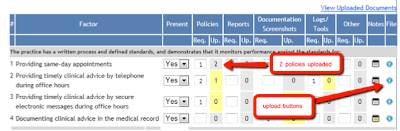
The tool tracks which documents have been uploaded


To view uploaded documents for your elements, click on the “Vew Uploaded Documents” link.
A popup screen will display listing all documents linked to this element.

You can view uploaded documentation by clicking here.


You can also add private Notes to each factor to share with others or for your own use. Simply click on the notepad icon.

If you’re working with a consultant or facilitator, you can allow them access to review your completed application. A section for reviewer notes have been included along with a checkbox for them to mark when the element is complete.

An external reviewer can add notes in this section


Sometimes you’ll notice a “Note” icon appear next to a Factor. This means that NCQA has REQUIRED additional information. Click on the note to add the necessary information. The icon will change color to indicate that content has been added.

The system alerts you when some notes are required by NCQA


This red box indicates that NCQA requires a note to be filled out here.


While the Summary tab provides you with an overall view of practice progress, the “NCA Submission” folder on the left displays all the documentation accumulated so far, including all Notes. This is where you can delete uploaded documents by clicking the red “X” next to the document name. Please note, this action cannot be undone.

You can print summary and detail status reports from the Summary page at any time. A copy will always be saved to your PCMH Documents folder for your records.

A picture of fireworks and the words, "BizMed's PCMH Tool is free for your practice - celebrate!"


There you have it. There may not be any free lunches in this world, but at least you can use this free PCMH Application!

Wednesday, November 14, 2012

The NCQA Medical Home Roadmap

Obamacare is here to stay, and with it a host of initiatives small and large, some intended and some not so much so, targeting massive transformation of the health care delivery system. One of those initiatives involves the adoption of the principles of a Patient Centered Medical Home (PCMH) for primary care as formulated by the primary care medical associations, and to a large extent, as translated into operational processes by the National Committee for Quality Assurance (NCQA). There are other implementations of the PCMH put forward by public and private organizations, but NCQA’s Medical Home recognition program is considered the gold standard for PCMH. The PCMH concept is also here to stay, and as is the case with Obamacare, the Medical Home model has its supporters, its detractors and all sorts of misconceptions and implementation missteps.

If you randomly ask a primary care physician about his/her opinion on the Patient Centered Medical Home model of primary care, you will most likely get one of the answers listed below in order of increasing prevalence:
  1. Absolutely fantastic way to practice medicine. We’ve been doing this for a while and are a Level III recognized Medical Home.
  2. The idea is good and we are currently making the transition and working on obtaining NCQA recognition. It’s not easy, but we are hopeful.
  3. We are part of a PCMH pilot in our state. It’s a lot of work and I am not convinced that it will have any benefits for my practice.
  4. I read about it, but I can’t afford to hire dieticians and social workers and spend time on all the paper work.
  5. I don’t have time for this.  Just a bunch of government regulations that do nothing for patient care.
  6. This is the final nail in the coffin of primary care. It’s going to drive all remaining independent physicians out of practice, which is what the government wants anyway.
  7. My mother-in-law is in an assisted living facility, but other than that I don’t have any patients in nursing homes….. I don’t take Medicaid.
  8. Say that again….?
Just like Obamacare is not something invented by overzealous socialists, but the brainchild of extremely conservative thinking, the PCMH is not a government invention, but instead it is based on a statement made by physician associations attempting to define good primary care and the need for insurers to pay more for such excellence. The devil of course is in the details. It’s been said that the “official” NCQA PCMH requirements consist of too many details, and that some of those details are bureaucratic in nature, burdensome, expensive and contribute little to patient care. It’s been said that true quality of care and practice transformation, whatever that may be, is largely independent of counting points, formal testing, certifications and recognitions.  Granted, all these contentions seem reasonable, but before deciding to walk away, how about a quick bird’s eye tour of what NCQA PCMH recognition really is?

The six parts of formal NCQA 2011 PCMH recognition are called Standards. Let’s take a critical look at each one and note the order in which they are arranged.

Standard #1 - Enhance Access and Continuity – Continuity here refers to people having a personal physician instead of seeing whoever happens to have time that day. I don’t know many practices where this is not the case anyway, but it’s hard to argue against the need to build a long term relationship between patients and their doctors, and it’s even harder to argue against this being the #1 foundational requirement of delivering high quality longitudinal patient care. Note that by definition solo practices are automatically set up to care for patients this way (just saying…). The second part of this Standard is a bit more problematic from a physician’s point of view, because it does require availability after hours and seeing patients the same day as much as possible. It is not an easy task to start tinkering with your schedule, if you are not currently offering same-day appointments, and done haphazardly, it may have serious financial implications to your practice. How about being available after hours, particularly for a solo or very small practice? How about your family and personal life? If you are one of the new concierge docs with a tiny panel of well-behaved patients, this is obviously not an issue. If you have 2500 patients, or so, on your panel, some creative thinking may be required. How would your patients react if, say, every Tuesday you’d start seeing patients from 12 pm to 8 pm? Or if you closed early on Wednesdays and twice a month you saw patients on Saturday mornings? Or if you had an arrangement with a couple of other practices to provide urgent care at odd hours on a rotating basis?

A recent study in the Annals of Family Medicine found that total health care expenditures were 10.4% lower for patients who had access to extended hours of care. This is great news for the “system”, but how about benefits to you and your practice? Whether you like it or not, you are now competing against business models with extremely low overhead, such as grocery store clinics and virtual tele-medicine clinics, offering pseudo-primary-care to your rushed and hurried patients for simple needs, leaving you to deal with complex visits that cost you a lot to deliver, but pay as much (or as little) as the simple ones. Unless you start thinking outside the box, your model of business is destined to become obsolete. Offering some electronic visits, providing hours for urgent care needs and collaborating with others on extended coverage may very well be a matter of survival. Interestingly enough, another recent JAMA study, although limited to community health centers, finds measurable correlation between access and continuity and lower operational costs per unit of service. There should be very little doubt at this point that Standard #1 is the place to start work on the viability of any practice, or ignored at significant peril.

Standard #2 - Identify and Manage Patient Populations – This one sounds onerous and a departure from individualized patient care, but is it really so? The “populations” term notwithstanding, all this Standard requires is that you document patient demographics and clinical information in the chart (seriously?), that you take good histories and that you send reminders to your patients to mind their chronic and/or preventive care needs. There is really nothing here that a good primary care physician doesn’t already do, and probably to a much greater extent than the NCQA standards specify. The one thing that may be different is that this Standard talks about proactive reminders to patients that don’t come in to see you on their own. Good for business and definitely good for patient care on an individual level.

Standard #3 - Plan and Manage Care – Another statement of the obvious, but this standard uses terminology that may raise some eyebrows. For example, it asks that your care is evidence-based. Is your care not evidence-based? Surely you decide how to treat patients based on your education, what you learned along the years, books, articles and latest research, instead of throwing darts at a random treatments list hanging in your office. And this is really all there is to this Standard, other than practicing medicine, i.e. seeing patients, evaluating conditions, planning care, talking to patients, and generally speaking, being their doctor. 

Standard #4 - Provide Self-Care Support and Community Resources – This may sound like the new age fluff of patients taking care of themselves, and granted, there is some of that here, but the details are again pretty straightforward in their intent to have patients understand their conditions and do something about it. Primary care docs don’t usually fit the much publicized portrait of aloof and paternalistic doctors who won’t give you the time of day. It is the time constraints in fully loaded practices that may prevent some from fully engaging with their patients, and no certification process will change that without proper shift in reimbursement, or a change to a more direct practice model with smaller patient panels. This Standard’s feasibility is also highly dependent on patients themselves, but there are simple things you and your staff can do to better enable patients to take some responsibility for their own health (most of which you are probably doing already), and this is all this Standard is about.

Standard #5 - Track and Coordinate Care – Do you send patients to specialists and then forget all about them? Do you order lab tests and don’t care if the results come in or not or if they are normal or not? Do you get calls from the hospital notifying you that one of your patients was admitted, and you hang up thinking that this is not your problem? No? Then you are tracking and coordinating care. Can you do more? Probably, but here you are largely at the mercy of specialists and hospitals in particular. You most likely already have tickler lists to help remind your staff about getting specialists notes and test results, but it is extremely difficult to have the hospital contact you if you are not admitting your own patients (and sometimes even if you do). There is effort (and costs) involved in better tracking and better coordination and payers are starting to take notice as evidenced by the latest care coordination CPTs added to the Medicare physician fee schedule.

Standard #6 - Measure and Improve Performance – Here it is. This is the measuring, reporting and all administrating bag of requirements, complete with patient satisfaction surveys, sending data to payers and using electronic medical records. While most items here are optional, a medical home is required to set some improvement goals for clinical measures (just goal setting, not necessarily outcomes). So after doing everything outlined in previous Standards, this is where the assumption is implicitly made that a medical home should be able to continuously improve the care it provides. Perhaps you believe that you are already providing excellent care, and no doubt most of you do, but is there anything more you can do? This Standard is asking you to consider this question, and if you have an answer, begin acting on it. And yes, this too may take more time and more effort on your part, and thus be dependent on payments to support these efforts.

Did I leave anything out? If your opinion of the PCMH was something along the lines of #6 above, you are probably wondering about some “strategic” omissions. How about all that “team care” and nurse practitioners? How about those case managers and dieticians? What of the need to buy, implement and use an expensive EMR? Well, for starters these things are optional in nature. Unless you are a team of one, you already have people helping you out with patient care and administration, and you are not required to use or augment your staff more than you are comfortable with. A good EMR should help, but it is not mandatory either. And yes, NCQA will recognize nurse practitioner led practices as medical homes, but this is reflective of legislation at State levels, and it should be appropriately addressed at a policy and legislative level as well. As to the infamous amounts of paperwork involved, yes, there is plenty of that, but there is also plenty of help out there and you just need to find it.

On the surface the NCQA PCMH recognition process is an administrative test for primary care, but if you look at it carefully, you can see that it is also a logically ordered roadmap for quality primary care and a tool for you to take a fresh look at your practice and position it to change with the times without having to sacrifice your ethics and your principles. Some things in this roadmap are at the heart of what you do every day, others are things that you may want to do if time and finances allowed, and few are in the realm of “forget it”. Unlike Meaningful Use, the NCQA PCMH “test” is not an all-or-nothing proposition and there is reasonable freedom for you to discard those “forget it” items, or postpone the wishful thinking for a better day. There should be financial benefits accruing from just doing some of the things on this roadmap (such as Standard #1), and there are financial incentives from payers for doing other things or from just “passing the test”.

The medical home is a timeless model of care, repackaged for these troubled and technology driven times, and as such, it is also a business model for the future of primary care. You could approach the entire exercise as yet another payer and government mandated intrusion, or you could make this roadmap your own, and look at it as a means by which to refine and sustain an already excellent practice. It is ultimately all up to you.
